Understanding Prediction Market Arbitrage
In this article, I’ll explore what are prediction markets and how one could take advantage of it to generate money with ~0 risk using arbitrage.
What are prediction markets
I will let the definition up to Wikipedia:
Prediction markets, also known as betting markets, information markets, decision markets, idea futures, or event derivatives, are open markets that enable the prediction of specific outcomes using financial incentives (gambling on real world events).
Basically, you trade on whether something will happen or not.
Here is one of the top market from Polymarket right now:
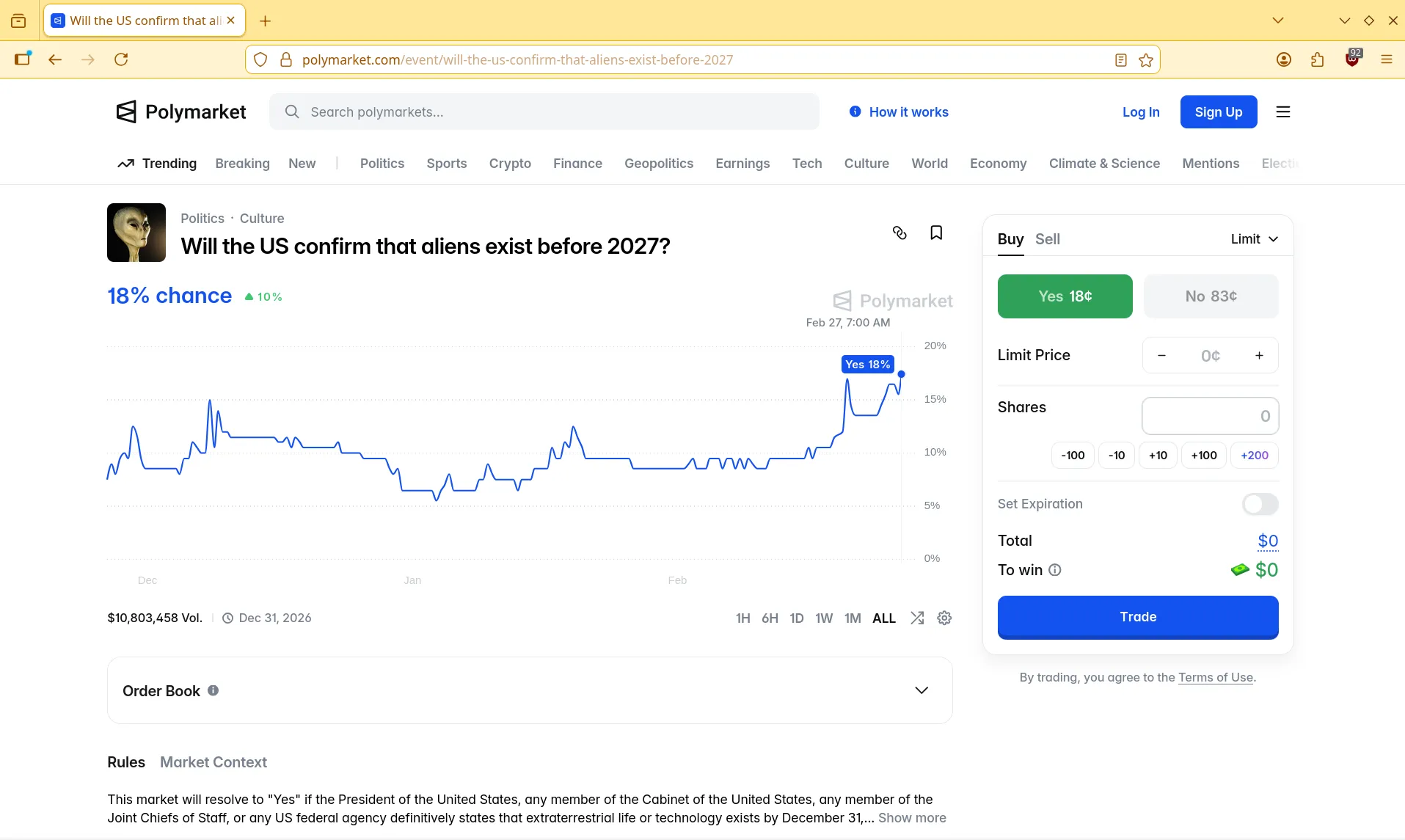
You can buy “yes” and “no” for a specific price. The worth of a “no” or a “yes” share might increase or decrease with time.
Building an intuition for prediction markets
To really understand prediction markets and what kind of opportunities they offer to us, let’s explore a few scenarios:
You bought “yes”, and one month later, the existence of aliens is confirmed by Donald Trump
Let’s say that Donald Trump and a bunch of officials come on TV and declare that aliens do exist.
This would check all the boxes for the market to resolve to “yes”:
This market will resolve to “Yes” if the President of the United States, any member of the Cabinet of the United States, any member of the Joint Chiefs of Staff, or any US federal agency definitively states that extraterrestrial life or technology exists by December 31, 2026, 11:59 PM ET. Otherwise, this market will resolve to “No”.
- president said that aliens exist
- he said that before 2027
In that case, the value of your “yes” share would jump from 18c to 100c, and will be automatically sold.
If you bought one share, that means that you earned 100c - 18c = 82c.
Let’s calculate the ROI using the standard formula:
However, we have to take into account the fact that this happened in one month.
What we are interested in though is annual ROI: our baseline is an investment in the S&P 500 and similar index funds, that for the sake of argument, we’ll assume earn 12% annualized. We need to get the annualized value for our prediction market “investment” in order to compare it to a growth ETF investment.
To do so, we are going to use this formula:
In our case, that gives us:
That seems pretty high. It’s because, it is super high! This demonstrates the power of prediction markets, especially if you know that something is going to happen on short notice (insider trading).
Let’s compare how much better investing into aliens appearing was a good idea compared to investing in a growth ETF:
As you can see, this strategy performed 462 times better than investing in an ETF.
Of course, you have to adjust for risk. The chance of the USA acknowledging the chance of aliens existing is pretty close to zero in my opinion, but they’re taking questionable decisions so I wouldn’t be so surprised.
Now, let’s explore what would happen if you bought “yes” but nothing happened…
You bought “yes” and nothing happened
This one is tough. Let’s say you bought a “yes” right now for 18c, on March 1st.
However, it’s now the 1st of January, and nothing happened. 306 days have passed since you bought.
Well, except that you received a notification from Polymarket… The market resolved to no, and your share was settled at $0.
This means that you irrevocably lost the 18c that you invested.
You lost everything.
You bought “no” and nothing happened
Let’s say you bought “no” for 83c on March 1st.
306 days passed, it’s now the 1st of January.
The price of your share increased from 83c to 100c and was redeemed at 100c.
Let’s calculate the ROI, and then, the annualized ROI.
Now, let’s annualize it:
Let’s compare how much better this is compared to investing in an ETF:
Buying no was 2.04 times better than investing in an ETF.
Taking risk into account
Now, there is of course no free money.
If there are 18% of the capital being bet into the fact that the market resolves to “yes”, there might be a reason.
My personal belief is that there is 0% chance that humans have definite proof that aliens visited earth.
However, the market is about something else entirely; it’s about the USA acknowledging the existence of aliens.
There is an obvious conflict of interest here. What if Donald Trump saw that market, and that it was worth enough for him to consider making a false announcement?
I believe that’s the reason this specific market is priced at 18%. It doesn’t even need to be Trump, this could be something that’s spearheaded by someone else in the White House.
If we take into account our belief that we don’t have definite proof of aliens existing, we can simplify the market to this: “will someone in the White House falsely claim that there are aliens?”.
If we assume that nobody would do that unless they would have strong incentives, we can rephrase it to: “would someone in the White House be corrupted enough to claim that aliens exist?”
Now, we start getting into the meat of it. I personally assign a chance of 10% to that happening.
This means that if we relived 2026 10 times, I believe that at least 1 year, we would see alien pictures on TV.
This information is pulled out of thin air because, like you, I am not in the white house. Even someone there would have a hard time estimating the probability because of the general irrationality going on there… unless they were the one about to break the news (insider trading!).
So, if we adjust for risk, we end up with an expected ROI of 8.45%.
But wait! We need to annualize it to compare it to an ETF.
We can compare it to the ROI of an ETF:
This means that “investing” in “no” is 16% less efficient than investing in an ETF.
This is why you won’t see the probabilities go to 0% in prediction markets if the deadline is in a long time; it just doesn’t make financial sense to let your money rest there. And you really don’t want to wake up scared every day that Trump might claim alien exists.
If you believe though that there is only 1% chance that the market resolves to yes:
Let’s annualize it:
And now, let’s compare it to an ETF:
This is almost two times better than an ETF, like we found before.
This is because a 1% risk is negligible.
Something is missing, though: we are not taking fees into account.
The goal here is not to create a rational betting system, but rather, creating an arbitrage system, so I’ll take fees into account into the formulas that calculate arbitrage ROI, rather than “betting” ROI.
Arbitrage: turning price discrepancies into hard cash
Sometimes, different prediction markets have identical markets, but with different prices.
Let’s consider our Alien market.
| Market | Yes price | No Price |
|---|---|---|
| Polymarket | 17c | 83c |
| Kalshi | 12c | 88c |
We can see that Polymarket is less optimistic that aliens exist.
What happens if we buy “No” on Polymarket and “Yes” on Kalshi?
We buy one share of each. Our total cost is 83c + 12c = 95c.
Then, let’s simulate the two market resolutions.
If the market resolves to “no”, then, the share we bought for 83c is now worth 100c. The share we bought for 12c is now worth 0c, though. We have a (current value of investment) of 100c.
We calculate the ROI:
If we annualize it:
If we compare it to an ETF:
This arbitrage opportunity is 47% less efficient than investing in an ETF.
This is why you don’t always see prices converging in prediction markets; the arbitrage is not always worth it.
Let’s imagine another scenario:
| Market | Yes price | No Price |
|---|---|---|
| Polymarket | 17c | 83c |
| Kalshi | 5c | 95c |
We are going to summarize everything in one big formula that gives us the performance multiple compared to an ETF and then calculate it step by step:
Let’s calculate it step by step:
This arbitrage opportunity is 35% more efficient than investing in an ETF.
Let’s consider an alternate scenario, where the market resolves to “yes” after 1 month; this is the same calculation, but with a different resolution date in the annualization calculation.
If it resolves to “yes” in one month, then we perform almost 14 times better than investing in an ETF. We can only get good surprises, with arbitrage! Either we get a faster resolution and get our money faster, so we can reinvest it, or we don’t and we get back our money anyway.
We could try and estimate the expected value taking an early resolution into account, but we would need to assign estimates to when it could resolve to “yes”. This gets us into gambling territory again (“I feel like there is 10% chance that someone in the White House says that aliens exists in March specifically”).
Building an automated system to profit from arbitrage
One could create a system that automatically detects and acts upon arbitrage opportunities.
You would need to:
- Build a Kalshi scraper
- Build a Polymarket scraper
- Match markets from Polymarket to markets from Kalshi
- Calculate the ROI(p.a.) for each of those arbitrage opportunities, including platform fees, leg risk (risk that one of the legs don’t fulfill), potential early fullfillment…
- Present them to the user in a way that’s easy to validate. I wouldn’t trust a LLM to take financial decisions.
- Execute the legs at the same time and in the right amounts
- If one of the legs failed, somehow undo the order from the other leg to recover the money
- Have a statistics dashboard
That really sounds trivial, but takes time. I’m almost halfways on this list, but then I hit a ceiling because I didn’t have a good intuitive understanding of arbitrage. I hope that writing this article helped me get over it :).
Conclusion
I know this is a little basic, but I hope that you learned something, or at least that it inspired you to give this a try.